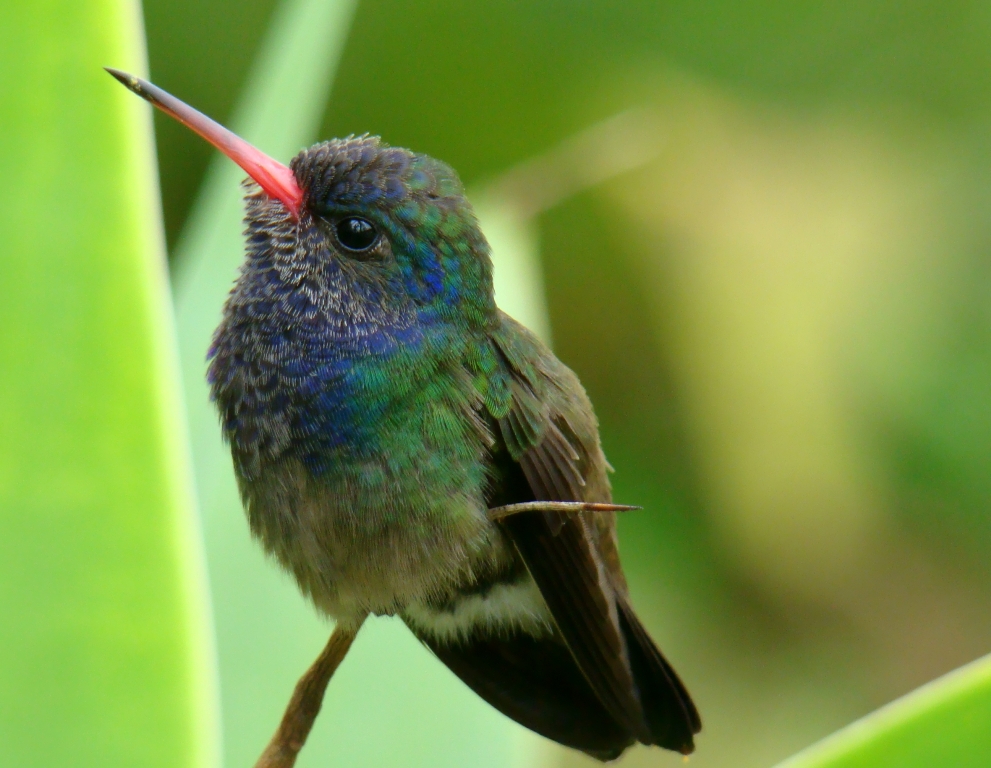
Hummingbirds a very adaptable species, and are spread all around the Americas. This means that they inhabit many biomes. In light of this, I have decided to focus on the bee hummingbird, the smallest species of hummingbird, which inhabits the forests in Cuba.
Bee hummingbirds are found in Tropical Forest biomes, and is endemic to Cuba. The biomes are found between latitudes 23.5°N and 23.5°S, near the equator, and cover about 6% of the world's surface. They are characterized by tall, dense trees, and a canopy of leaves high above the ground. This canopy typically blocks out a large amount of sunlight from shining on the ground. These areas usually get over 100 inches of rain every year, and the temperature is typically between 20°C and 34°C. Because of their closeness to the equator, Tropical Forests have around 12 hours of sunlight year-round, with only slight variations from the Earth's tilt. There are only two distinct seasons in these biomes; a rainy season and a dry season. The length of each varies depending on the area. Humidity is very high, staying between 77 and 88%.
Tropical Forests have very diverse flaura and fauna populations. One example is the red eyed tree frog. They are named for their very large, bright red eyes. When these frogs close their eyes, their green color allows them to blend in with the surrounding leaves. Scientists believe that their eyes have evolved as such for a defense mechanisms known as "startle colorization". Red eyed tree frogs are nocturnal, and therefore have no form of defense during the day, save for their camouflaging color. If they were woken by a predator, and opened their eyes, the stark color could scare the predator away. Another example is the boa constrictor. Adult boas are usually around 13 feet long, with the females generally being smaller. Their color varies by region, but are generally brown and tan, with a distinct pattern running down their length. This coloring allows them to camouflage themselves with the forest floor, an adaptation that has helped them survive their forest environment. A final example is the Rafflesia flower. These are found in south-east Asia, and holds the record for the largest blooming flower in the world. They are parasitic, and have evolved to taste like dung or rotten meat. Their red color also warns flies and other forest creatures to stay away, allowing for it to survive.
Tropical Forest biomes are in danger of being completely wiped out due to human deforestation. This is a major issue, as rainforests are predicted to hold half of the world's species of plants and animals, and are essential ecosystems. Large companies chop down their towering trees and sell the wood for a high profit, yet never replant anything, leaving only barren fields and creatures without a habitat. Houses and other human settlements are also built on the grounds of these forests. This can be solved by passing and enforcing anti-deforestation laws, which would require the support of politicians and lawmakers not just in America, but around the world. But that would not necessarily be enough; miles and miles of habitats would have to be rebuilt, by planting millions of new trees. This would be terribly difficult, though if enough support was gained, not impossible.
The bee hummingbird functions as a nectar-feeding pollinator for plants within its ecosystem. It has a mutualistic relationship with many plants species; the plants provide nutrients for the hummingbird through their nectar, while the hummingbird spreads pollen to other plants, aiding in cross breeding among species.
The bee hummingbird is both a primary and secondary consumer. It is primary because it drinks the nectar from flowers, which are producers, directly. It is a secondary consumer because it eats small insects within these flowers, which themselves feed on the pollen in the flowers. Tertiary consumers like hawks hunt these hummingbirds as well. Hawks are at the top of the food chain, and therefore have no predators. The bee hummingbird does not have very many competitors, save for insects. It's main competition, however, comes as the Cuban Emerald Hummingbird, known as the "zun-zun" in Cuba. The Cuban Emerald is larger than the bee hummingbird, with the average males being about 10cm in length. They both must compete for nectar from flowers, as they have very similar diets, and both help to pollinate flowers within their ecosystems.
Sources:
"CUBAN FALCONIFORMES - Falcons, Hawks, Eagles, Ospreys." CUBAN BIRDS. N.p., n.d. Web. 14 Oct. 2015. <http://www.nhptv.org/wild/cubanbirdsFalconiformes.asp>.
Ballard, Kacey. "The Forest Biome." The Forest Biome. Ed. Stephanie Pullen. UCMP Berkely, Fall 1996. Web. 13 Oct. 2015. <http://www.ucmp.berkeley.edu/glossary/gloss5/biome/forests.html>.
"Bee Hummingbird." Wildscreen Arkive. N.p., n.d. Web. 13 Oct. 2015. <http://www.arkive.org/bee-hummingbird/mellisuga-helenae/>.
"Boa Constrictor." Fact Sheet. N.p., n.d. Web. 14 Oct. 2015. <http://nationalzoo.si.edu/Animals/ReptilesAmphibians/Facts/FactSheets/Boaconstrictor.cfm>.
"CUBAN FALCONIFORMES - Falcons, Hawks, Eagles, Ospreys." CUBAN BIRDS. N.p., n.d. Web. 14 Oct. 2015. <http://www.nhptv.org/wild/cubanbirdsFalconiformes.asp>.
"The Forest Biome." The Forest Biome. N.p., n.d. Web. 14 Oct. 2015. <http://www.ucmp.berkeley.edu/exhibits/biomes/forests.php#tropical>.
"Rafflesia Arnoldii (corpse Flower)." Rafflesia Arnoldii (corpse Flower). N.p., n.d. Web. 14 Oct. 2015. <http://www.kew.org/science-conservation/plants-fungi/rafflesia-arnoldii-corpse-flower>.
"Tropical Deforestation : Feature Articles." Tropical Deforestation : Feature Articles. N.p., n.d. Web. 14 Oct. 2015. <http://earthobservatory.nasa.gov/Features/Deforestation/>.
"Viñales Valley." - UNESCO World Heritage Centre. UNESCO, n.d. Web. 13 Oct. 2015. <http://whc.unesco.org/en/list/840>.
Tropical Forest biomes are in danger of being completely wiped out due to human deforestation. This is a major issue, as rainforests are predicted to hold half of the world's species of plants and animals, and are essential ecosystems. Large companies chop down their towering trees and sell the wood for a high profit, yet never replant anything, leaving only barren fields and creatures without a habitat. Houses and other human settlements are also built on the grounds of these forests. This can be solved by passing and enforcing anti-deforestation laws, which would require the support of politicians and lawmakers not just in America, but around the world. But that would not necessarily be enough; miles and miles of habitats would have to be rebuilt, by planting millions of new trees. This would be terribly difficult, though if enough support was gained, not impossible.
The bee hummingbird functions as a nectar-feeding pollinator for plants within its ecosystem. It has a mutualistic relationship with many plants species; the plants provide nutrients for the hummingbird through their nectar, while the hummingbird spreads pollen to other plants, aiding in cross breeding among species.
The bee hummingbird is both a primary and secondary consumer. It is primary because it drinks the nectar from flowers, which are producers, directly. It is a secondary consumer because it eats small insects within these flowers, which themselves feed on the pollen in the flowers. Tertiary consumers like hawks hunt these hummingbirds as well. Hawks are at the top of the food chain, and therefore have no predators. The bee hummingbird does not have very many competitors, save for insects. It's main competition, however, comes as the Cuban Emerald Hummingbird, known as the "zun-zun" in Cuba. The Cuban Emerald is larger than the bee hummingbird, with the average males being about 10cm in length. They both must compete for nectar from flowers, as they have very similar diets, and both help to pollinate flowers within their ecosystems.
Sources:
"CUBAN FALCONIFORMES - Falcons, Hawks, Eagles, Ospreys." CUBAN BIRDS. N.p., n.d. Web. 14 Oct. 2015. <http://www.nhptv.org/wild/cubanbirdsFalconiformes.asp>.
Ballard, Kacey. "The Forest Biome." The Forest Biome. Ed. Stephanie Pullen. UCMP Berkely, Fall 1996. Web. 13 Oct. 2015. <http://www.ucmp.berkeley.edu/glossary/gloss5/biome/forests.html>.
"Bee Hummingbird." Wildscreen Arkive. N.p., n.d. Web. 13 Oct. 2015. <http://www.arkive.org/bee-hummingbird/mellisuga-helenae/>.
"Boa Constrictor." Fact Sheet. N.p., n.d. Web. 14 Oct. 2015. <http://nationalzoo.si.edu/Animals/ReptilesAmphibians/Facts/FactSheets/Boaconstrictor.cfm>.
"CUBAN FALCONIFORMES - Falcons, Hawks, Eagles, Ospreys." CUBAN BIRDS. N.p., n.d. Web. 14 Oct. 2015. <http://www.nhptv.org/wild/cubanbirdsFalconiformes.asp>.
"The Forest Biome." The Forest Biome. N.p., n.d. Web. 14 Oct. 2015. <http://www.ucmp.berkeley.edu/exhibits/biomes/forests.php#tropical>.
"Rafflesia Arnoldii (corpse Flower)." Rafflesia Arnoldii (corpse Flower). N.p., n.d. Web. 14 Oct. 2015. <http://www.kew.org/science-conservation/plants-fungi/rafflesia-arnoldii-corpse-flower>.
"Tropical Deforestation : Feature Articles." Tropical Deforestation : Feature Articles. N.p., n.d. Web. 14 Oct. 2015. <http://earthobservatory.nasa.gov/Features/Deforestation/>.
"Viñales Valley." - UNESCO World Heritage Centre. UNESCO, n.d. Web. 13 Oct. 2015. <http://whc.unesco.org/en/list/840>.